



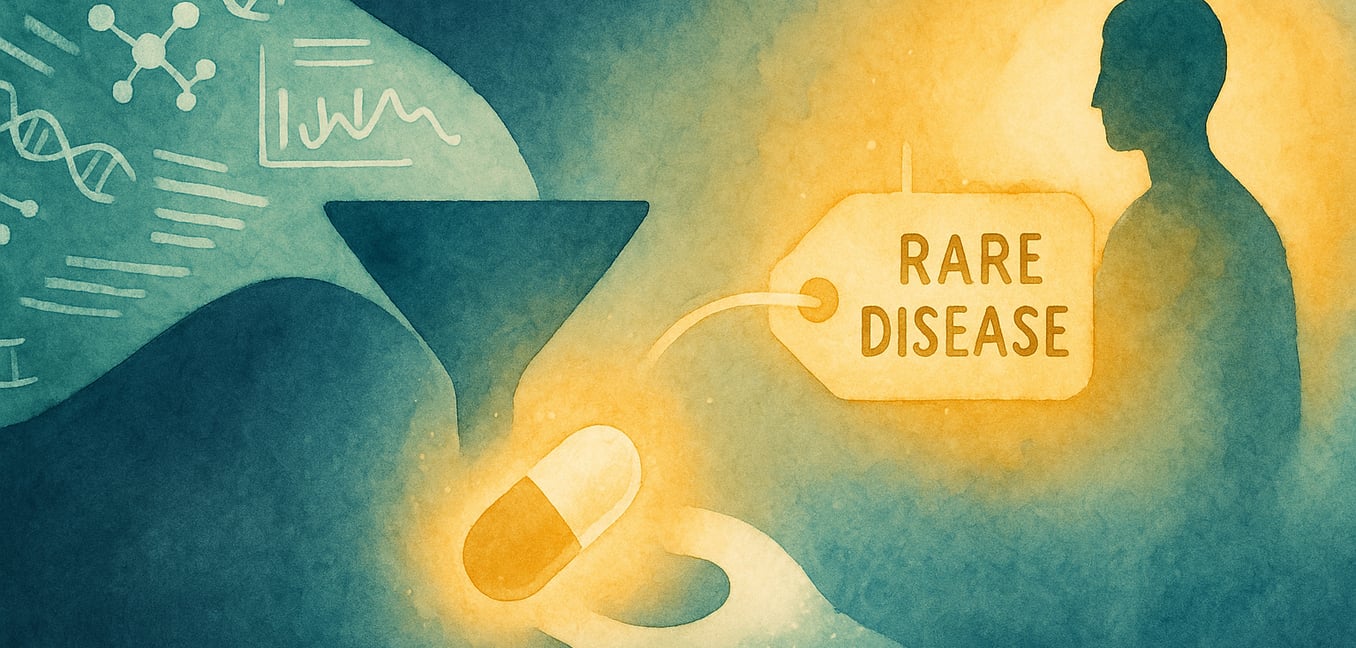





For so many families in our community, the journey with an ultra-rare disease begins with a question mark. It’s a path that often involves a long, frustrating search for answers that leads to a life of managing complex symptoms, frequently without a therapy that addresses the root of the problem. We know this journey can be incredibly challenging, and we want you to know that on this path, you are not alone.
Today, we want to walk with you through a story of incredible scientific progress that is bringing a new chapter of hope. This is a deeper dive into the science, the challenges, and the landmark progress of drug repurposing, an approach that is helping scientists find new uses for existing medicines. We believe that by understanding the journey from discovery to treatment, we can have more informed conversations, ask better questions, and march forward together with a clearer sense of what the future holds.
The Promise of an Old Idea
The challenge facing the rare disease community is immense. There are over 7,000 known rare diseases, yet only about 5% have an approved treatment, leaving millions of people without therapies for their conditions. Developing a new medicine from scratch is a long and expensive process, often taking over a decade and costing billions of dollars. For diseases with small patient populations, this often means that new drug development is not seen as financially viable.
This is where drug repurposing comes in. It’s the strategy of identifying new therapeutic uses for medicines that have already been approved for other conditions. The core advantage is that these drugs have already gone through extensive safety testing. Because their safety in humans is already understood, the path to getting them to patients for a new use can be significantly faster and less costly.
For a long time, repurposing happened mostly by accident. You might be familiar with some of these serendipitous discoveries:
-
Aspirin: Originally sold as a pain reliever, it was later found to act as a blood thinner to prevent cardiovascular events.
-
Sildenafil (Viagra): It was first investigated for heart conditions before its unexpected side effects led to its repurposing for erectile dysfunction.
-
Minoxidil: Developed as a blood pressure medication, it found a new life as a treatment for hair loss.
These "lucky accidents" showed that a single drug could have multiple effects in the body. But for the thousands of rare diseases without treatments, waiting for luck isn’t a strategy. The big change today is the shift from accidental discovery to a systematic, intentional search, powered by incredible technology.
AI: A Powerful New Tool in the Search
The reason a systematic search was impossible before is the sheer amount of information involved. It would be beyond human capacity to analyze every existing drug against the complex biology of every rare disease. This is where Artificial Intelligence (AI) has become a game-changer.
Think of AI as a tireless, brilliant detective. It can read and understand vast libraries of data—from scientific publications and clinical trial reports to complex genomic and proteomic data—at a speed no human could ever match. By processing all this information, AI can identify subtle, non-obvious patterns and connections. It might find, for example, that the way a high blood pressure drug works on a molecular level is very similar to a key pathway involved in a rare genetic disorder.
This isn’t just about speeding up the process; it’s about generating new ideas that researchers may not have thought of otherwise. For rare diseases, where information is often fragmented, AI’s ability to connect these disparate dots is profoundly important for uncovering opportunities that would otherwise remain hidden.
A Real Story of Life-Saving Hope
This approach is already having a tangible, life-altering impact. One of the most powerful success stories comes from the fight against Idiopathic Multicentric Castleman's Disease (iMCD), a rare and deadly inflammatory condition.
A physician and iMCD patient himself, Dr. David Fajgenbaum, was in a race against time. An AI tool was used to analyze thousands of existing drugs, and it identified a medication called adalimumab—typically used for arthritis—as a promising candidate. At the same time, lab work confirmed that the protein this drug blocks was indeed a key driver of the disease. For one patient who was critically ill and facing hospice care, this AI-guided insight was life-saving; treatment with adalimumab led to remission.
Inspired by this success and his own journey, Dr. Fajgenbaum co-founded the non-profit "Every Cure" to use AI to systematically find repurposed treatments for all diseases. This story is a powerful testament to how AI can provide real answers and profound hope in situations where none existed before.
Marching Forward Together: Hope, Realism, and the Journey Ahead
The approval of any new therapy for a rare disease is a victory for the entire community. It’s a testament to the resilience of the patients and families who participate in clinical trials and the dedication of the researchers who champion this progress.
At the same time, we walk this path with both hope and honesty. AI is a huge step forward, but it is not a "magic bullet" that replaces the need for careful science. Every promising candidate identified by AI must still be rigorously tested in clinical trials to confirm that it is truly safe and effective for the new rare disease. A drug that is safe for one condition might have different side effects in a new patient group.
Furthermore, the quality of AI’s predictions depends entirely on the quality and quantity of the data it learns from. For many ultra-rare diseases, data is scarce, which remains a significant hurdle.
This is what the forward march of progress looks like. It is a dedicated, meaningful step that shifts the paradigm from luck to strategy. It opens the door for more research and inspires the next wave of innovation. As we watch these new frontiers of medicine unfold, we are committed to providing you with clear, trustworthy information. Your insights, your experiences, and your hope are what fuel this forward march. On this journey of discovery, you are not alone.
Sources
-
National Center for Biotechnology Information. (2021). Drug Repurposing for Rare Diseases. https://www.frontiersin.org/articles/10.3389/fmed.2024.1352803/full
-
BPAS Journals. (2024). Ai-Driven Drug Repurposing: Uncovering Hidden Potentials Of Established Medications For Rare Disease Treatment. https://www.researchgate.net/publication/385898731_Ai-Driven_Drug_Repurposing_Uncovering_Hidden_Potentials_Of_Established_Medications_For_Rare_Disease_Treatment
-
Frontiers in Medicine. (2024). Artificial intelligence in drug repurposing for rare diseases: a mini-review. https://www.frontiersin.org/articles/10.3389/fmed.2024.1404338/full
-
Avalere Health. (2024). Drug Repurposing: Potential to Expand Rare Disease Treatment. https://avalere.com/insights/drug-repurposing-potential-to-expand-rare-disease-treatment
-
MDPI. (2022). Repositioning Drugs for Rare Diseases Based on Biological Features and Computational Approaches. https://www.mdpi.com/2227-9032/10/9/1784
-
Every Cure. (2023). First Life Saved with AI-Discovered Repurposed Medicine for Castleman Disease with Significant Potential Applications to Treat Other Illnesses. https://everycure.org/every-cure-announces-breakthrough-at-stat-summit/
-
Nature Research. (2013). Sildenafil: from angina to erectile dysfunction to pulmonary hypertension and beyond. https://www.nature.com/articles/nrd2220